Why Our Trees Are Falling: The Silent Crisis of ‘Blind’ Pruning
By: Dr. Anjulika Joshi
Look closely at the trees lining our streets. Do they look like natural, majestic canopies, or do they look like bare poles topped with a small, struggling tuft of leaves? If it is the latter, our cities have a problem.
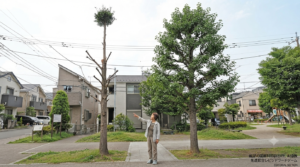
In urban areas, “pruning” has become synonymous with “stripping.” To manage growth near power lines or buildings, workers are often instructed to remove almost all side branches. While intended to reduce “nuisance,” this practice—scientifically termed lion tailing—is creating structural disasters.
A tree is a living structure. When it grows wide, its weight is distributed, and its branches act as dampers, absorbing wind energy. By stripping the sides and leaving all the weight at the very top, we turn the tree into a long, heavy mast. When a storm hits, the physics is simple: the top moves, the trunk acts as a lever, and the roots, unable to bear the concentrated torque, give way. If one looks abroad, it is evident that trees in many other countries maintain a uniform height and balanced girth, standing resiliently without the constant danger of falling—a direct result of standardized, scientific pruning methodologies. Instead, cities are essentially pruning trees into becoming falling hazards.
It is time to stop viewing trees as static infrastructure and start treating them as biological assets. There must be a shift from “utility-driven clearing” to “scientific arboriculture.” Trees do not need to be pruned to death; they need to be managed for resilience. For a greener, safer city, professional pruning standards must be adopted to honor the natural architecture of trees—giving communities the shade, the air quality, and the stability so desperately needed.
What Changes in Policy/Law Are Required?
The legal landscape currently focuses on permitting or restricting the act of pruning, but it lacks scientific standardization.
Standard Operating Procedure (SOP) based on Arboriculture: The current debate centers on whether a branch of a certain girth can be pruned. The law should instead regulate how it is pruned. Governments need to mandate that any pruning on public land be done under the supervision of a certified arborist or a trained horticulturist, not just a maintenance worker with a saw.
Mandatory Training for Civic Agencies: Agencies like the MCD, NDMC, and PWD should be required to provide “Arboriculture Training” for their field staff. This training must explicitly ban “topping” and “lion tailing” as standard practices.
Inclusion of ISA Standards: Tree preservation acts could be strengthened by incorporating specific technical definitions of “scientific pruning” based on International Society of Arboriculture (ISA) guidelines.
Tree Census & Health Audits: City-wide tree censuses are needed that do not just count trees but track their health. This would allow authorities to identify trees that actually need structural pruning (to prevent failure) rather than just indiscriminate trimming.
What Can Communities and Citizens Do?
As a collective society and community network, meaningful change can be driven through unified advocacy:
Document and Report: When “lion tailing” or “topping” is spotted in neighborhoods, communities must document it. Taking photos of the before-and-after and sending them as formal complaints to local Horticulture Departments or the Deputy Conservator of Forests (DCF) highlights the argument of “Public Safety”—proving that this practice creates an imminent danger of tree-falls.
Request “Crown Cleaning” instead of “Clearance”: When engaging with local councillors or Resident Welfare Associations (RWAs), the correct terminology must be used. Communities should ask for Crown Cleaning (removing dead/diseased branches) or Selective Thinning (removing specific small branches to allow airflow) instead of destructive “pruning.”
Educate Neighborhoods and RWAs: Since many residents mistakenly think the “clean, pole-like” look is healthier, local groups can host community sessions or share visual leaflets showing the difference between a naturally structured tree and a “lion-tailed” one.
Leverage Local Governance: By working alongside local councillors, citizens can present this as a “Smart City” initiative: Better tree management means fewer falling trees and lower disaster management costs for the public.
Author


About The Author