
The Green Dilemma: Is Delhi’s EV Boom Swapping Dirty Air for Toxic Landfills?
By Dr. Anjulika Joshi
Director, Pallav Green Foundation
Walk down any street in Delhi today, and you will notice a quiet change. Electric cars, scooters, and autos are gliding through our neighborhoods. To fight our city’s infamous air pollution, the government is pushing hard for Electric Vehicles (EVs) by giving heavy discounts and tax cuts. In fact, Delhi’s updated rules aim to make almost one-third of all vehicles on the road electric over the next few years.
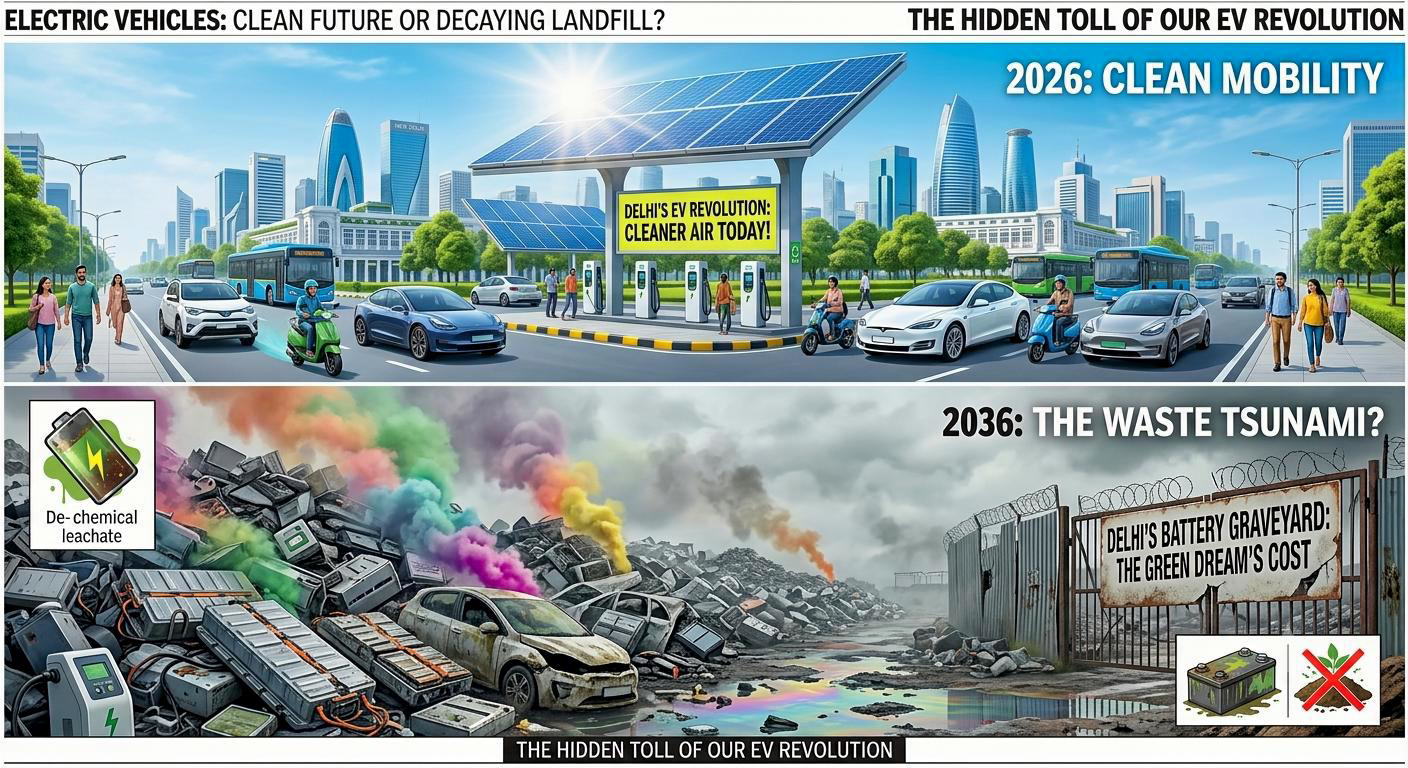
It is a fantastic effort to help us breathe easier. But as we look ahead, a big question pops up: Are we solving an air crisis today, only to create a massive garbage crisis tomorrow?
To make sure the EV dream does not backfire, we need to fix two major worries that the public has on their minds right now.
Two Big Worries: Charging and Dying Batteries
The first problem is simple: Where do I charge it? Many people want to buy an EV but hesitate because public charging stations still feel few and far away. The fear of getting stuck on a busy road with a dead battery—often called “range anxiety”—keeps many people from making the switch.
The second, much bigger problem lies a decade into the future. What happens when millions of these massive car batteries grow old and die?
An EV battery lasts about 8 to 10 years. If we do not have a solid plan, millions of dead batteries will eventually end up in our landfills. These are not ordinary household batteries; they are huge, and they are packed with chemicals and heavy metals. If they are tossed into regular garbage dumps, those chemicals can leak into our soil and underground water, poisoning the very earth we grow our food in. We are already drowning in electronic waste (e-waste) like old phones and laptops. Adding massive car batteries to that pile could break the system entirely.
Simple Solutions for a Truly Green Future
We at the Pallav Green Foundation strongly urge both the government and the citizens to look toward a genuinely sustainable future. We don’t have to choose between clean air and clean soil. We can have both if we collaborate on a few smart, practical solutions across different levels:
1. On a Personal and Community Level:
- Give Batteries a “Second Life”: When an EV battery becomes too weak to run a car, it isn’t actually “dead”—it still holds about 70% of its power. Instead of throwing it away, we can reuse it. The Pallav Green Foundation advocates for setting up these batteries in apartment buildings or solar plants to store electricity and provide backup power during outages. This gives the battery a second life for another ten years.
2. On a Government and Policy Level:
- Make Car Companies Responsible: We need a strict law that says: If you make the car, you must take back the dead battery. India’s environmental laws already demand this, but enforcement must be watertight. By putting unique QR codes on every battery, the government can track them from the factory floor to the recycling plant, making sure not a single one gets dumped illegally.
- Put Chargers Everywhere: To take away the fear of running out of charge, plugging in a vehicle should be as easy as parking it. The government should help local housing societies (RWAs) and market areas install low-cost charging points. If we power these stations with solar energy, the cars become truly green.
- “Mine” the Old Batteries: Instead of digging up the earth for new materials, we can treat dead batteries like a goldmine. Advanced recycling factories can safely open them up and recover up to 90% of the valuable metals inside, like lithium and cobalt. These recovered metals can go straight back into making brand-new batteries.
The Bottom Line
Delhi needs electric vehicles to clean up our skies—there is no doubt about it. But a vehicle is only truly “green” if it is clean from the day it is built to the day it is scrapped. By setting up a proper recycling system today, we can ensure our green journey leaves behind a cleaner, safer planet for our children. The Pallav Green Foundation invites every citizen to join this movement to protect both our sky and our soil.
Author


About The Author